BLOG 1 — SAFETY | Why Do I Always Feel Like I Have to Be Strong? How Men Can Get Out of Survival Mode
By WiL Turner
Men’s Health Advocate, Fitness, Relationship & Personal Growth Coach Founder of Living Well With WiL & The Becoming Whole Men’s Health Movement
“Survival teaches a man how to endure. Healing teaches him that he no longer has to live as though everything is a threat.” — WiL Turner
Introduction
For many men, being strong has meant learning how to survive. We learn to keep working, pay the bills, protect the people we love, solve problems, suppress fear, and keep moving regardless of what may be happening internally. Strength becomes synonymous with endurance, and endurance can eventually become an identity. The problem is that a man can become so accustomed to surviving that he no longer recognizes when survival mode has followed him into circumstances where he is finally allowed to live.
A man can have a successful career, a home, relationships, friends, financial stability, and significant accomplishments while internally feeling as though everything could fall apart at any moment. He may find it difficult to rest, trust other people, ask for help, or enjoy what he has built because part of him remains prepared for the next crisis. This is why Safety is the first principle of Becoming Whole. Before a man can fully pursue belonging, confidence, love, purpose, expression, freedom, or legacy, he needs a foundation of physical, emotional, relational, and financial security
NEUROSCIENCE: WHAT SURVIVAL MODE DOES TO THE BRAIN & BODY
The human stress-response system exists to protect us. When the brain perceives danger, the sympathetic nervous system and hypothalamic-pituitary-adrenal, or HPA, axis help mobilize the body. Heart rate increases, attention narrows, and stress hormones such as adrenaline and cortisol help prepare us to respond. During an immediate threat, this response can be lifesaving. Problems can develop when stress is persistent and the body repeatedly receives the message that danger is never completely over.
Chronic stress can influence sleep, mood, concentration, digestion, memory, decision-making, and emotional regulation. A man who has spent years navigating instability, financial strain, discrimination, trauma, rejection, family conflict, or unpredictable relationships may become accustomed to hypervigilance. His nervous system may begin responding to uncertainty as if it represents a larger threat than the situation actually presents.
The brain also learns through repetition. If overworking, emotional suppression, control, avoidance, or extreme independence repeatedly helped a man survive difficult circumstances, those responses can become reinforced patterns. Changing them usually requires more than simply telling yourself to relax. It requires repeated experiences of stability, healthy connection, rest, reflection, regulation, and safety.
WHY THIS MATTERS
Living in a constant state of survival affects far more than stress. It can influence how a man sleeps, eats, exercises, works, communicates, manages money, responds to conflict, and connects with other people. He may become highly productive while simultaneously becoming emotionally exhausted. He can accomplish a great deal without ever experiencing the peace those accomplishments were supposed to provide.
The danger is that chronic stress can become normalized. Irritability becomes “just how I am.” Exhaustion becomes ambition. Emotional distance becomes independence. Hypervigilance becomes responsibility. A man may not recognize the cost until his health, relationships, or quality of life begins demanding his attention” — the verb agrees with the nearest subject, “quality of life.
It is difficult to build belonging, esteem, love, purpose, expression, freedom, or legacy when most of your internal resources are still devoted to survival.
DEMOGRAPHIC & SOCIAL-PSYCHOLOGICAL IMPACT
Survival mode does not look identical across all men. Black men may carry the additional strain of racial stereotypes, discrimination, code-switching, concerns about safety, and expectations to remain controlled under pressure. Gay men may experience vigilance related to rejection, family acceptance, discrimination, identity concealment, or determining whether particular social environments are genuinely safe.
Straight men may experience strong provider expectations or traditional ideas of masculinity that discourage asking for help. Young men may feel pressured to establish identity, income, status, relationships, and independence simultaneously. Men over 40 may carry accumulated stress from careers, health changes, aging parents, caregiving, divorce, financial responsibility, grief, or major life transitions.
Fathers may believe they cannot struggle because everyone depends on them. High-achieving professionals may appear successful while privately operating from anxiety and fear of failure. These differences remind us that safety is not merely an individual issue. It is shaped by culture, history, identity, environment, relationships, and access to resources.
IMPACT ON ROMANTIC RELATIONSHIPS
Survival mode can also keep male friendships emotionally shallow. Men may talk about sports, careers, entertainment, fitness, or everyday life while avoiding conversations about loneliness, grief, money, fear, relationships, or uncertainty.
Healthy brotherhood creates room for men to remain strong without having to perform strength constantly. Real connection allows men to support one another before a crisis becomes a collapse
IMPACT ON FRIENDSHIP & BROTHERHOOD
Survival mode can also keep male friendships emotionally shallow. Men may talk about sports, careers, entertainment, fitness, or everyday life while avoiding conversations about loneliness, grief, money, fear, relationships, or uncertainty.
Healthy brotherhood creates room for men to remain strong without having to perform strength constantly. Real connection allows men to support one another before a crisis becomes a collapse.
BOUNDARIES, SOLUTIONS & HEALTHY PRACTICES
Creating greater safety may involve strengthening sleep, movement, nutrition, financial habits, routines, healthy relationships, and stress-management practices. Breathing, meditation, self-reflection, journaling, physical activity, time outdoors, and meaningful social connection can all help increase awareness of how the body responds to stress.
Boundaries also matter. A man cannot continually expose himself to instability, disrespect, chaos, and unhealthy relationships while expecting his nervous system to experience peace. Sometimes creating safety means deciding what and who no longer receive unlimited access to your life.
BECOMING WHOLE PRINCIPLE 1: SAFETY
Safety does not mean nothing difficult will ever happen. It means difficulty no longer governs your entire life. Becoming Whole begins by helping men strengthen the internal and external foundations necessary for growth.
The question shifts from
“Can I survive this?” to
“What do I need to actually live well?”
REFLECTION
- Where in my life am I still responding as though I am merely trying to survive?
- What would help me feel more emotionally, physically, relationally, or financially secure?

Your journey toward wholeness begins by creating a life in which you feel safe enough to grow. Explore Becoming Whole Men’s Health Coaching, support groups, fitness experiences, workshops, and personal-growth resources through Living Well With WiL.
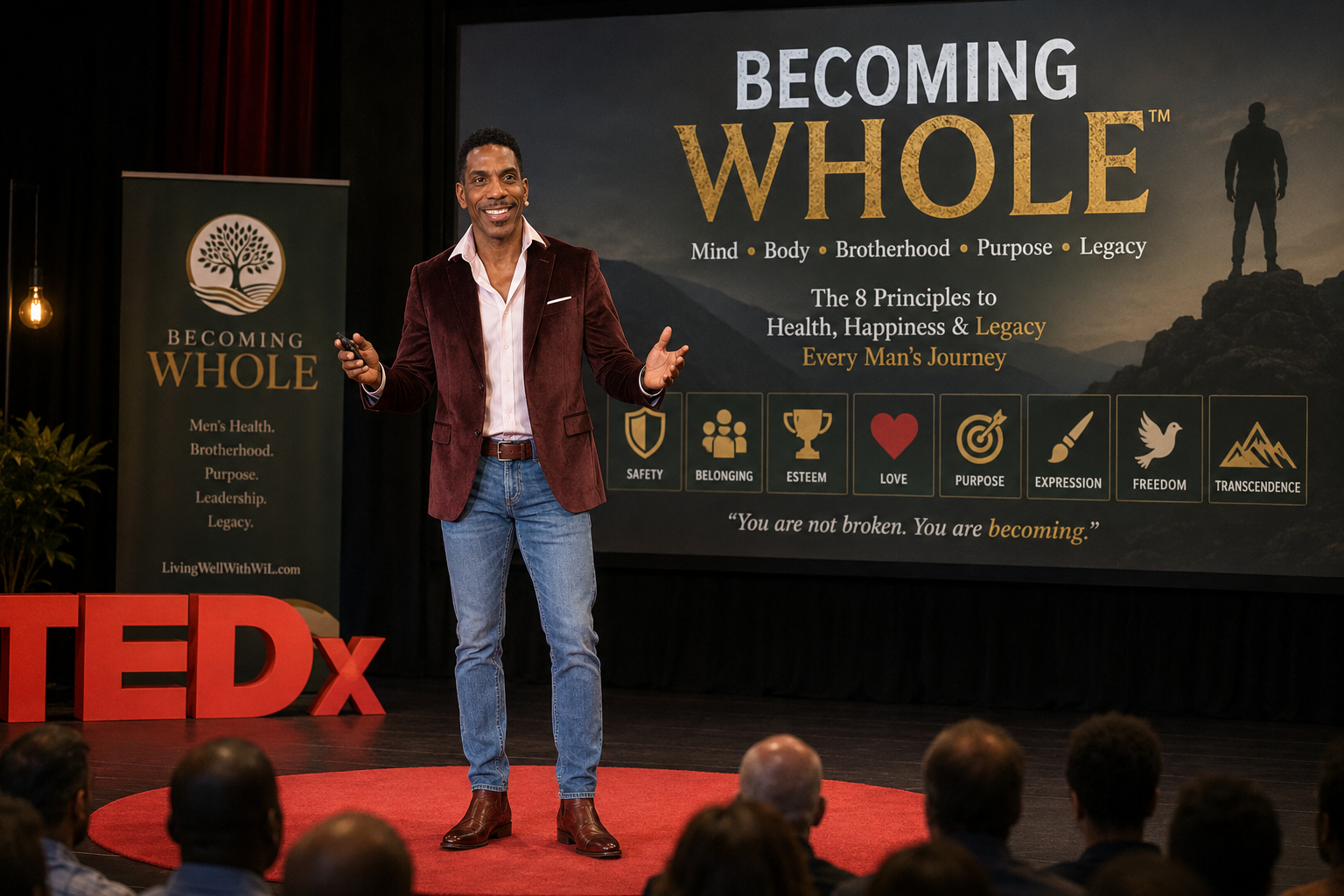
This article is part of The 8 Principles of Becoming Whole™ — a Living Well With WiL series exploring men’s health, happiness, relationships, purpose, leadership, and legacy.